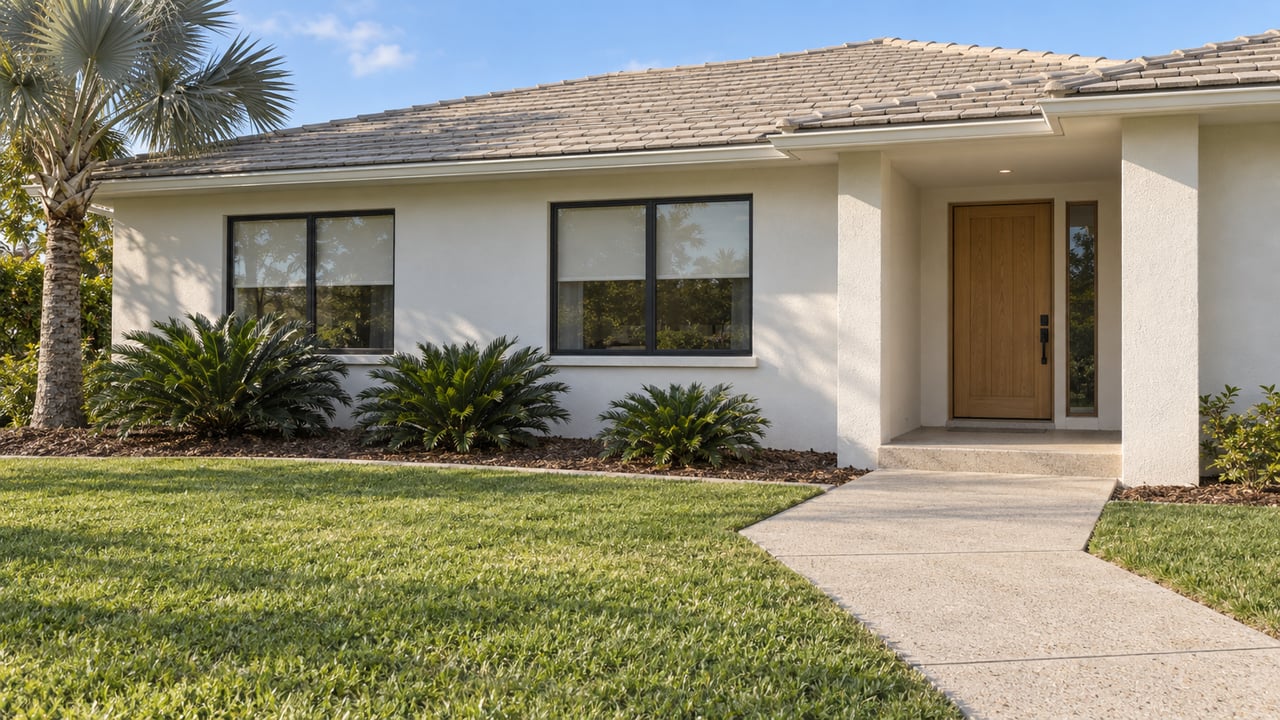
At Avenir, the Monthly Payment Is on Sale. The Price Isn't.
Kolter Homes advertises a reduced payment at Esprit at Avenir, and its own disclosure shows when that payment ends. The illustration assumes a $675,000 purchase, a $540,000 conventional loan and a note rate fixed at 6.625%. With a seller-funded 2-1 buydown, monthly principal and interest is $2,766.35 in year one, $3,108.54 in year two and $3,457.68 for the remaining 28 years. With the 3-2-1 version, year one starts at $2,462.68. Starting in year four, the payment is the same $3,457.68.
Same house, same loan, same final payment. The buydown changes when you pay, and the disclosure says plainly that it "does not reduce the loan amount, principal balance, or note rate." For a buyer in Palm Beach Gardens deciding between a new home at Avenir and a resale elsewhere in the city, that distinction matters more than any advertised rate. Builders are discounting the early years of the payment. Resale sellers in the county are under less pressure to discount anything. The two offers are negotiated on different terms, so they need to be compared on the same ones.
Here is the schedule from Kolter's Esprit at Avenir disclosure, with the year-by-year differences worked out from its figures.
| Year | 2-1 buydown, monthly P&I | 3-2-1 buydown, monthly P&I | Full note rate, monthly P&I |
|---|---|---|---|
| 1 | $2,766.35 at 4.625% | $2,462.68 at 3.625% | $3,457.68 at 6.625% |
| 2 | $3,108.54 at 5.625% | $2,766.35 at 4.625% | $3,457.68 |
| 3 | $3,457.68 | $3,108.54 at 5.625% | $3,457.68 |
| 4 onward | $3,457.68 | $3,457.68 | $3,457.68 |
Multiply those monthly gaps over the subsidized years and the 2-1 example is worth about $12,486 in reduced payments. The 3-2-1 is worth about $24,426. On a $675,000 house, that's under 2% and about 3.6% of the price. Both totals come from Kolter's illustration, and actual offers vary by home. The payments shown also exclude taxes, insurance and HOA fees, so the full monthly cost will be higher.
Fannie Mae explains how the money moves. A temporary buydown deposits a lump sum in an account and releases part of it each month to cover the difference in the early payments. The note rate and the permanent payment stay the same. The funds sit in a custodial bank account. They generally aren't refundable unless the loan is paid off before they're used up.
One detail affects how much house a buyer can afford. Kolter's disclosure says the borrower "must qualify based on the full note rate and loan terms, not the temporary buydown payment," and Fannie Mae's Selling Guide requires underwriting at the note rate too. A buydown makes the first years easier. It doesn't raise the price you qualify for.
Nationally, builders are under pressure. The NAHB/Wells Fargo Housing Market Index released October 19, 2026 fell to 29, its lowest reading since June 2012. Its measure of prospective buyer traffic dropped to 18. In October 2026, 43% of builders cut prices, the highest share NAHB has recorded since 2020. The average cut held at 6% for a seventh straight month, and 65% of builders used sales incentives. October was the 19th consecutive month that at least 60% did.
Mortgage rates explain much of that. Freddie Mac's survey for the week ending October 15, 2026 put the 30-year fixed average at 7.40%, up from 6.27% a year earlier. When rates rise, buyers start with the monthly payment. In its June 2026 earnings call, Lennar described rate buydowns and closing-cost help as aimed at buyers who qualify based on monthly payment rather than purchase price.
There's another reason a builder might prefer this structure, and this part is our reading rather than anything a builder has said. A price cut is recorded on the sale and becomes the comparable the next appraisal in the community is measured against. A buydown spends similar money while keeping the recorded price where it was. Fannie Mae's rules point the same way. Seller and builder contributions above its limits are treated as sales concessions and subtracted from the sales price. Past a certain point, then, the lender treats an incentive as a price reduction anyway.
Under Fannie Mae's interested-party contribution rules, a builder counts as an interested party, and buydown costs count toward the limit. For a principal residence or second home, the caps are:
Apply those limits to Kolter's example. The buyer puts $135,000 down on $675,000, an 80% loan, so the cap is 6%, about $40,500. The 3-2-1 subsidy of roughly $24,426 fits under it. The same 3-2-1 on that price with less than 10% down would run into the 3% cap of about $20,250. So a buyer with a smaller down payment may not be able to use the full incentive another buyer gets.
This is general information, not financial or legal advice. Loan programs differ, so confirm your own limits and terms with your lender.
Palm Beach County's resale single-family market is moving the other way from builder sentiment. According to the MIAMI REALTORS® September 2026 South Florida market report, countywide single-family figures for September 2026 compared with a year earlier were:
| Palm Beach County single-family, September 2026 | Value | Change from September 2025 |
|---|---|---|
| Active inventory | 4,481 | down 19.64% |
| Months supply | 3.6 | down from 5.0 |
| Median time to contract | 43 days | down from 51 |
| Share of original list price received | 95% | up from 93% |
| Median sale price | $656,000 | up 6.67% |
| Share paid in cash | 44.7% | up from 43.6% |
These are county numbers, not figures for Palm Beach Gardens alone. Still, they show resale sellers facing less competition than a year ago, getting closer to their asking prices and going under contract faster. With nearly half of sales paid in cash, many resale buyers aren't financing at all.
So the two negotiations differ. A builder discounts the payment because buyer traffic is weak and rates are high. A resale seller with less competing inventory is more likely to negotiate on price, if at all, and any reduction is permanent. A resale buyer can also ask for seller concessions, which fall under the same Fannie Mae limits. A 2-1 buydown worth about $12,500 and a $12,500 reduction on a resale both cost the seller about the same. The difference is when the buyer feels it. The buydown is gone after two years. The price reduction lowers the loan for its full term.
The fine print at Avenir matters as much as the advertised rate.
At Toll Brothers' Regency at Avenir, the builder's page advertised a limited-time 30-year fixed rate of 5.49%, or 5.76% APR, on select homes. It listed quick-move-in homes from $1.174 million to $1.374 million and designs from $664,995. Toll's National Sales Event took deposits from October 3 through October 25, 2026, and that window is now over. Ask the sales team what is offered now.
Is the 6.625% note rate in Kolter's example a market rate? It's an illustration based on a 740 credit score, an owner-occupied home and a $540,000 conventional loan. Freddie Mac's national average for the week ending October 15, 2026 was 7.40%, but your quote depends on your own loan.
Can I use a buydown on an investment property? Kolter's offer is for primary residences only, and Fannie Mae caps seller contributions on investment properties at 2%.
What happens to unused buydown money if I sell early? Under Fannie Mae's rules, the funds generally aren't refundable except when the loan is paid off before they're used up. Your loan documents will say how that works for your loan.
If you're comparing a new Avenir home with a resale in Palm Beach Gardens, I'm happy to set the two offers side by side, using the year-three payment and the price that would be recorded on each. Lynda Molina can help you see what each seller is actually giving up before you sign. Let's Connect.
Experience personalized service, strategic guidance, and a commitment to helping you achieve the best possible outcome in today's real estate market.