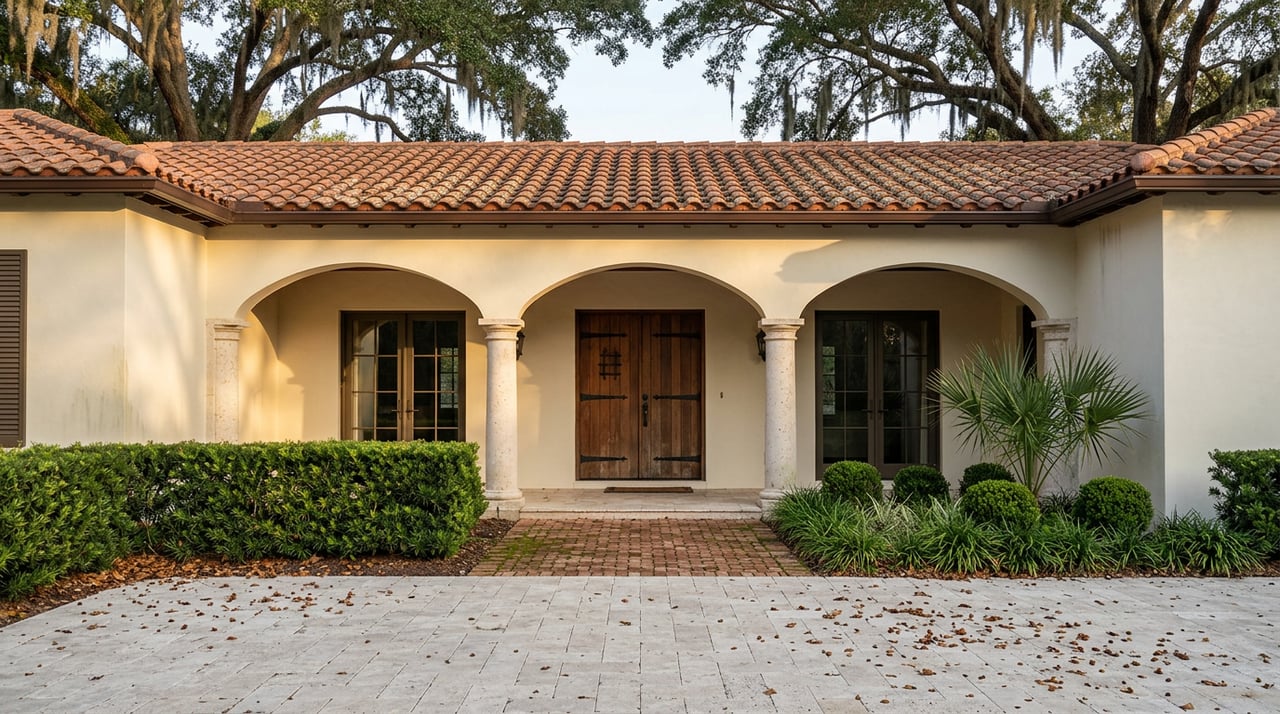
The Fine Print Behind Loxahatchee's "No HOA" Promise
Every listing description for a property in The Acreage repeats the same phrase. No HOA. Bring your horses, build your barn, keep your goats, nobody's architectural review board is coming to measure your fence height. For a buyer coming from a deed-restricted community in Palm Beach Gardens or a condo association in West Palm Beach, that phrase reads like relief.
Then the closing disclosure arrives, and there's a line item nobody mentioned during the showings: an annual per-acre assessment to a public body called the Indian Trail Improvement District. It isn't an HOA. It's something else, and the difference matters more than the vocabulary suggests.
The Indian Trail Improvement District was created by the Florida Legislature in 1957 to manage water control across what's now a 95-square-mile stretch of central Palm Beach County covering The Acreage and Loxahatchee. It functions as a special taxing district, not a homeowners association, which means it has government authority to assess landowners directly rather than relying on a voluntary membership structure. ITID does not receive general funding from the state or county the way a municipality does. Every mile of road it grades, every canal it dredges, every park it maintains gets paid for by the roughly 50,000 residents living across the district's 27,000 assessed acres.
That structure explains why the fee exists at all. There's no city of Loxahatchee sending a public works crew, and there's no county road department responsible for the interior streets. If ITID doesn't do it, nobody does. The assessment isn't a substitute for an HOA's amenity fee. It's closer to a mandatory public utility bill for infrastructure that a municipality would otherwise cover with property tax revenue you're already paying separately.
For fiscal year 2026, the twelve-month budget cycle that runs through the end of this month, ITID's board took up an operating budget that raised total district spending from about $19.9 million to roughly $24.6 million, according to the Town-Crier's coverage of the district's summer 2025 budget meetings. Most property owners had seen their per-acre assessment held flat near $947 for two straight years before that. The new budget pushed that figure to approximately $1,065 per acre for most of the district's units, with the exact increase ranging from as little as $11 to as much as $230 depending on which of ITID's 21 assessment units a given parcel sits in.
This is a real, recurring, per-acre bill layered on top of standard Palm Beach County property tax. On a modest two-acre parcel, that's over $2,100 a year just for district assessment. On five acres, it's closer to $5,300. The district maintains 458 miles of roads, more than 250 of them still unpaved dirt, along with 164 miles of canals that keep this low-lying land from flooding in a summer storm. Some of that money is also funding specific capital work right now, including a lighting replacement at Acreage Community Park North, an approximately $750,000 project the district is paying off over three years.
None of that is a criticism of the district. Someone has to grade 250 miles of dirt road, and the alternative to a special assessment is either no maintenance or a municipal tax structure the area has historically rejected. The point is narrower: "no HOA" describes the absence of one specific cost, not the absence of a recurring one.
Here's where the math gets genuinely local instead of theoretical. Two parcels on the same road in The Acreage can carry different practical costs depending on something the listing photos won't show you: whether the road fronting each one is paved county right-of-way, an unpaved district-maintained road, or a private easement that neither the county nor ITID is obligated to maintain at all.
Seminole Pratt Whitney Road is the paved north-south spine that most Acreage traffic eventually reaches, but plenty of interior residential streets branching off it are still unimproved. A parcel on a paved segment means predictable access, easier insurance underwriting in some cases, and less dust settling on your landscaping every time a neighbor drives by too fast. A parcel on an unpaved segment might sit on ITID's stabilization schedule, or it might not, and the district's own maintenance map is a more reliable way to check before you write an offer than a listing agent's description of the street.
Private easements are the sharpest version of this problem. If your only legal access runs across a recorded easement rather than a public or district road, maintenance responsibility typically falls to whoever holds the easement, which can mean you and a small group of neighbors are personally on the hook for grading and drainage that ITID would otherwise handle for free as part of your assessment.
The road question is the first cost surprise. The second lives underground. Most of Loxahatchee and The Acreage runs on private wells and septic systems rather than county water and sewer, and Florida's disclosure framework here is thinner than buyers moving from a sewer-connected suburb tend to expect.
Florida has no statewide law requiring a septic inspection before a sale closes, unlike states with a mandatory pre-transfer evaluation. The Florida Department of Health in Palm Beach County regulates onsite sewage systems and oversees permitting for repairs, but the burden of finding a problem before closing generally falls on the buyer's own inspection contingency, not on a state-mandated checkpoint. Florida's disclosure law, dating back to the 1985 Florida Supreme Court decision in Johnson v. Davis, only requires a seller to disclose defects they actually know about and that a buyer couldn't reasonably discover on a normal walkthrough. A septic system that's failing quietly underground and that the seller genuinely doesn't know about creates no disclosure obligation at all.
In practice, most lenders close that gap. FHA and VA financing typically require evidence the septic system is functioning, which pushes an inspection into the process even without a state mandate. A standard septic evaluation runs a few hundred dollars. A full drain field replacement, if the inspection turns up a real problem, can run anywhere from roughly $5,000 to $15,000 for a conventional system, and as much as $12,000 to $30,000 for a mound or aerobic treatment unit replacement, the kind more common on larger rural lots.
The well side carries its own quiet risk that has nothing to do with disclosure law: the pump runs on electricity. When the power goes out during storm season, and outages tend to last longer at the end of a rural feeder line than they do closer to the coast, the well stops producing water entirely. A generator with a plan for the pump isn't an upgrade out here. It's closer to a baseline expectation.
Before writing an offer on Acreage or Loxahatchee acreage, it's worth confirming a short list of specifics that a listing sheet won't answer on its own:
Average sale prices across The Acreage over the trailing twelve months have come in near $664,285, up about 5 percent from the prior twelve-month period. Homes here have also been taking longer to sell than the broader market, averaging around 64 days on market against a national figure closer to 47.
That gap in days on market isn't a sign of weak demand. It's a sign that acreage transactions carry more due diligence than a standard suburban sale, from well and septic verification to confirming which government body actually maintains the road. Buyers who skip that homework close faster and sometimes regret it. Buyers who do it properly take a little longer and know exactly what they're carrying.
The average sale price tells you what the land costs. It doesn't tell you what it takes to hold it. That second number, the assessment, the road type, the well and septic condition, is the one worth understanding before you compare Loxahatchee against anywhere else in Palm Beach County, because it's the number that actually determines whether the space and privacy are worth the tradeoff for your specific plans.
Does every property in Loxahatchee or The Acreage pay the ITID assessment? Most parcels within ITID's boundaries do, but the district covers a defined geographic footprint. Some sections of Loxahatchee, including parts of the separately incorporated Town of Loxahatchee Groves, fall outside ITID and operate under different governance entirely. Confirming which jurisdiction applies to a specific parcel is a first step, not an afterthought.
Is the per-acre assessment the same every year? No. It's set annually through ITID's public budget process and can change based on infrastructure needs, grant funding the district receives, and which of the 21 assessment units a parcel belongs to. Some units also carry separate bond obligations tied to specific capital projects in their area, on top of the standard assessment.
If you're weighing acreage in Loxahatchee against a more conventional lot elsewhere in Palm Beach County, the honest comparison has to include both the freedom this land offers and the specific costs attached to it. That's the kind of conversation worth having before you fall for a listing photo. Lynda Molina works across Palm Beach County's full range of communities, from equestrian acreage to waterfront and golf communities, and can walk through exactly what a given parcel's numbers mean before you write an offer. Let's Connect.

Discover this stunning waterfront home in Miramar's River Run community, featuring modern upgrades, a chef-inspired kitchen, and serene water views.
Experience personalized service, strategic guidance, and a commitment to helping you achieve the best possible outcome in today's real estate market.